

EVCI’s physical layer: installation and operation roles
To understand the hardware layer, components must be separated by how they deliver power, how they are accessed and how they serve specific vehicle types.
Power tiers
Alternating current (AC) charging
This delivers electricity from the grid directly to the vehicle's onboard charger, which then converts it to direct current to charge the battery. Because it relies on the vehicle's internal conversion capacity, AC charging is typically slower (usually between 3 and 22 kilowatts) and best suited for long-stay locations like homes, overnight depots or offices.
Rapid direct current (DC) charging
This converts electricity from alternating current to direct current within the charging station itself, bypassing the vehicle's onboard charger to deliver power straight to the battery. Operating typically between 50 and 150 kilowatts, rapid DC charging significantly reduces charging times and serves as the standard for quick turnaround fleet hubs and urban commercial settings.
Ultra-fast charging (UFC)
Also referred to as high-power charging (HPC), this tier delivers power outputs from 150 kilowatts up to 400 kilowatts. By utilizing liquid-cooled cables and advanced power electronics, ultra-rapid chargers can top up compatible EV batteries to 80% capacity in 10 to 20 minutes, making them essential for motorway transit corridors and high-utilization logistics hubs.
Megawatt charging
At the absolute top end of the power scale sits megawatt charging, a next-generation standard designed specifically for heavy-duty commercial transport like class 8 trucks, shipping port vehicles and coaches. Operating at up to one megawatt or more, these systems cut charge times for massive battery packs from hours to minutes.
Access models and operational roles
Every piece of physical charging hardware requires operational ownership to dictate how stations are run, how networks interconnect and how drivers gain access. This operational landscape is driven by charge point operators (CPOs), who are typically the ones building or commissioning the infrastructure in the first place, then managing the day-to-day technical health, uptime and load constraints of a network they have built. On the consumer side, e-mobility service providers (eMSPs), handle driver accounts, map navigation and billing. In practice, the line between the two is not always clean – some CPOs operate their own eMSP, while others focus purely on the physical network and partner with dedicated eMSPs through roaming agreements. Either way, those roaming agreements are what allow drivers to plug into different physical networks without creating separate accounts for each location.
Public charging
Public charging covers charge points accessible to any EV driver at any time, typically found on public streets, in municipal car parks or along motorways.
Semi-public charging
This covers locations like workplace offices, retail customer lots or hotels where access is restricted to certain hours or to a defined group of users. The distinction matters commercially because pricing structures, regulatory requirements and operator responsibilities differ significantly between public and semi-public sites.
The regulations shaping the buildout
Two layers of regulation directly shape where infrastructure gets built and how assets interact with local electrical grids.
Infrastructure buildout frameworks
- Alternative Fuels Infrastructure Regulation (AFIR): This is the European Union (EU) standard setting mandatory targets for public charging across member states. It specifies minimum power levels at regular intervals on major road networks and sets interoperability and payment requirements for public charge points.
National and regional programs fill in the gaps, each managed by distinct government bodies that dictate local compliance and funding:
- DeutschlandNetz (Germany): This is a federally funded initiative to build high-power charging hubs at regular intervals along motorways and in urban areas, delivered through concession contracts with private operators.The Federal Ministry finances the continuous deployment of the 'DeutschlandNetz' with an updated allocation of approximately €2.3 billion. This active funding framework covers over 1,000 deployment locations to establish a baseline grid of 9,000 ultra-rapid high-power charging (HPC) points.Additionally, the federal government runs a €1 billion electric truck charging scheme to fast-track regional depot and public megawatt-level freight corridors.
- Netherlands Enterprise Agency (RVO): In the Netherlands, the RVO acts as the primary agency executing EVCI policy and managing the National Charging Infrastructure Agenda. For private and commercial premises, the RVO actively handles the €87.5 million Private Charging Infrastructure for Businesses (SPRILA) grant scheme, which provides direct subsidies of up to 40% covering commercial charging stations alongside co-located stationary battery storage to mitigate grid congestion. For public heavy-duty transport, the RVO administers the €14.5 million Public Charging Infrastructure for Heavy Electric Vehicles (SPULA) fund to expand high-power logistics networks.
- Office for Zero Emission Vehicles (OZEV): In the United Kingdom (UK), 'OZEV' is the cross-government team that develops policy and allocates major funding frameworks to subsidize installation and drive commercial vehicle electrification. OZEV oversees the active £450 million Local Electric Vehicle Infrastructure (LEVI) fund to deliver charging infrastructure for residents without off-street parking. This framework actively distributes capital into targeted local authority allocations alongside dedicated capability funds to build out public-private operator coordination structures.

Commercial and grid connection regulations
- §14a of Germany's Energy Industry Act: This regulation allows grid operators to temporarily reduce the power of controllable consumption devices, including EV chargers, during periods of grid stress. Operators register controllable assets (with an individual or combined capacity above 4.2 kW) and accept occasional automated curtailment down to a safe baseline of 4.2 kW per asset in exchange for permanently reduced grid fees. For standard commercial properties and large-scale EVCI networks consuming over 100,000 kWh per year, the site shifts to an interval-metered configuration (Registrierende Leistungsmessung). At this meter level, the infrastructure operator is legally restricted to a fixed flat-rate network fee reduction, making automated energy management system (EMS) orchestration vital to maintain site optimization without losing core fleet turnaround metrics.
- The Dutch Energy Act (Energiewet): This comprehensive legislative framework addresses grid congestion deficits by legalizing local congestion management, flexible transport rights and capacity sharing. It allows business parks and EVCI operators to pool energy profiles behind a single meter via Group Transport Agreements, bypassing utility bottlenecks.
- G100: In the UK, G100 is the strict technical engineering regulation set by the Energy Networks Association governing export and import limitation schemes for energy storage and distribution systems. Because it serves as a critical site safety mechanism, any commercial setup deploying battery storage alongside ultra-fast EV infrastructure and any controllable consumption device must use a local controller to guarantee import limits are never exceeded. gridX's local gateway, the gridBox, is fully G100-compliant, executing local fail-safe limit logic driven by XENON software algorithms. By deploying this intelligence at the edge, the gridBox ensures local site safety and dynamic load throttling even during internet outages. This hardware-agnostic solution allows charge point operators (CPOs) to get fast grid connection approvals without being locked into a single charger manufacturer.
EVCI’s software layer: management and optimization platforms
Hardware requires software sitting above it to master operational efficiency. This part is where communication protocols are operated, uptime is monitored and holistic asset steering is deployed via an energy management system.
Core management systems
- Charge point management system (CPMS): This is the foundational software platform operators use to monitor charge point status, manage user access, handle billing and collect session data. The CPMS is the operational backbone of a charging network, handling everything from fault alerts to usage reports.
- Depot or fleet management system: For commercial EV fleet operators with a dedicated depot for charging, this software coordinates charging schedules with route planning and vehicle availability, making sure every vehicle leaves with the exact charge it needs. Rather than managing local electrical limits natively, a DMS sets the logistical timeline, allowing an integrated energy management system (EMS) to dynamically execute those power demands while protecting the site's grid connection.
- Energy management system (EMS): This is the overarching software layer that sits above individual charge points and integrates EVCI with the broader local energy ecosystem, including on-site photovoltaic (PV), battery storage systems, heat pumps and building electrical loads. While a standard CPMS handles session data and basic driver authorization, an EMS strategically steers the timing and volume of power delivered to chargers based on real-time building demand, weather patterns and external utility grid conditions. Additionally, a sophisticated EMS integrates deeply into the macro-grid, actively responding to direct utility grid commands and real-time wholesale market signals. This dual-layer automation safeguards the local grid connection against overloads while automatically shifting consumption to lower-priced hours, significantly improving operating margins for the infrastructure operator.
Technical backbone and protocols
All software coordination depends on devices being able to communicate reliably. An EMS, a CPMS and a depot management system require common languages to pass information, request data and issue control commands. The industry relies on a specific set of open standards to define exactly how these data points, telemetry streams, and operational commands flow between hardware assets, local edge systems and cloud platforms
- Open Charge Point Protocol (OCPP): This is the globally accepted standard for communication between individual charge points and central management systems. It defines how a charger reports its status, receives operational commands and transmits session data, ensuring interoperability between differing hardware manufacturers and software backends.
- Open Automated Demand Response (OpenADR): This is an open standard protocol for automated demand response. It allows utilities or market aggregators to send price or curtailment signals directly to a site, enabling the CPMS or the EMS to automatically adjust its charging load without manual operator intervention.
- Message Queuing Telemetry Transport (MQTT): This is a lightweight, publish-subscribe messaging protocol used to move telemetry data between localized chargers and cloud backends. It is favored in setups where network bandwidth is limited or ultra-low latency is required for real-time monitoring.
- Modbus: A foundational serial communication protocol common in industrial automation and power electronics equipment. It appears frequently in charge points, smart sub-meters and building systems; because of its low protocol overhead and exceptional stability, gridX explicitly supports EVCI deployments via Modbus to ensure high-performance, real-time deterministic steering and seamless integration with local industrial hardware.
- International Electrotechnical Commission 60870-5-104 (IEC 104): This telemetry standard is used to connect power system control centers to remote equipment. In large industrial EVCI deployments where charging hubs interface directly with distribution grid control systems, IEC 104 is the mandatory communication standard.
Managing loads to protect the grid and the commercial tier
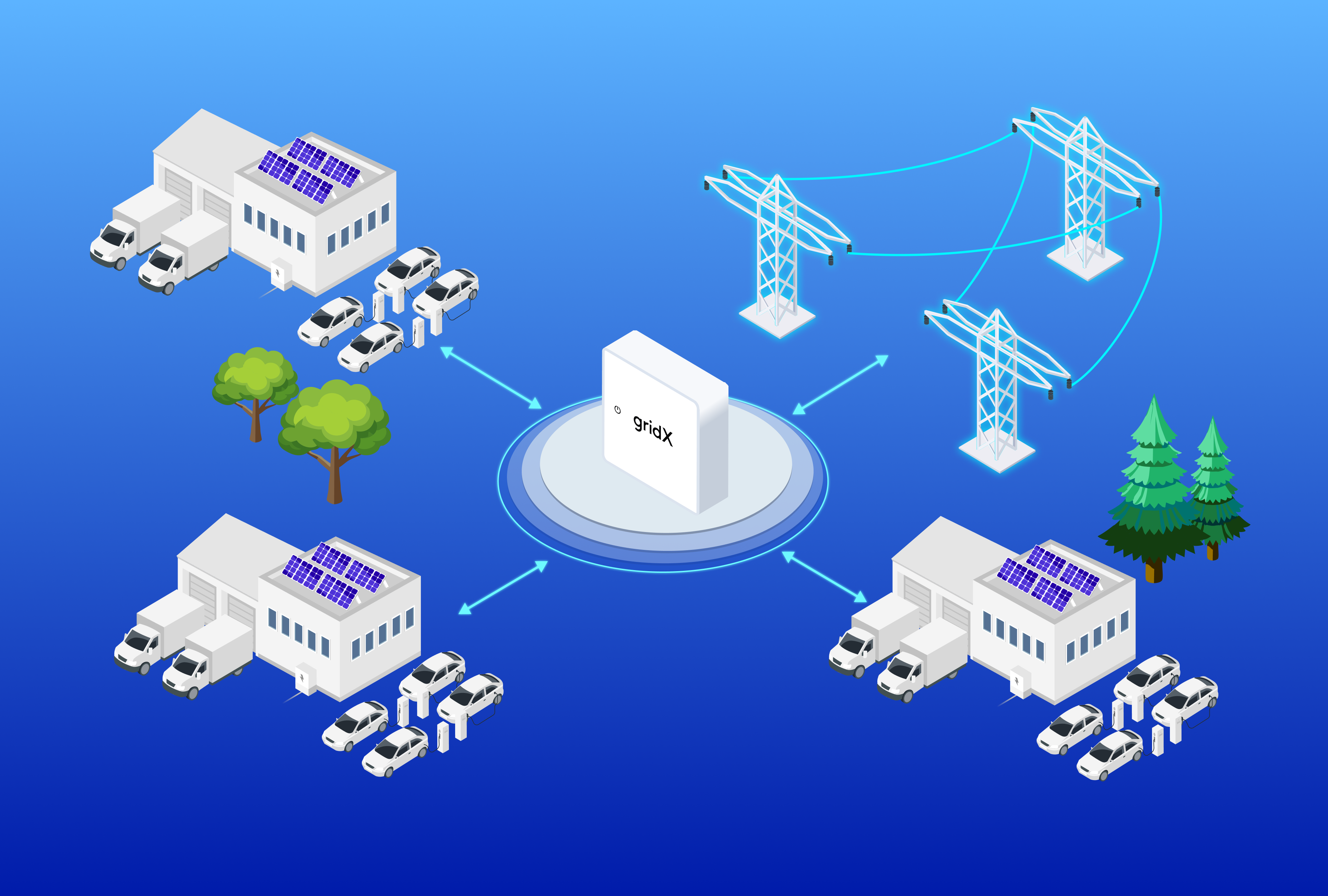
This is where load management becomes critical. Every site has a fixed amount of power available from the grid either limited physically or virtually. Without energy management software to master how that power is distributed, a site will hit its limit the moment several vehicles plug in simultaneously. Powered by the gridX’s local gateway, the gridBox, and integrated APIs, gridX’s XENON (Connect) Platform transforms static hardware limits into automated operational rules across three distinct value tiers.
1. Standard control
This foundational tier focuses on local site protection and automated baseline load steering to safeguard physical assets and respond to immediate grid safety signals.
- Fuse protection: A hardware-protecting software mechanism that continuously monitors total electrical currents at critical site bottlenecks. If total charging site demand spikes, the system automatically throttles charge points to ensure local physical fuses never trip.
- Dynamic load management: The smarter alternative to fixed caps. Because the physical grid capacity of a site remains constant, the EMS continuously monitors changing building demand and automatically allocates the remaining load to chargers in real time. As charging site consumption fluctuates, the system dynamically redistributes power across charge points to suit charging demand as best as possible, maximizing charging speeds while ensuring total site consumption never crosses the grid capacity limit.
- Peak shaving: The active reduction of maximum power drawn during high-demand periods. Because grid operators charge commercial sites based on their highest consumption peak in a billing period, an EMS flattens these spikes – often steering on-site battery storage to absorb excess load – to eliminate expensive demand charges. Based on gridX's internal calculations, peak shaving unlocks significant savings potential, reaching up to €10,000 per year depending on the specific site characteristics, utility demand-charge structures and the local distribution system operator (DSO).
- Regulatory compliance: Enables site operation in line with local regulations by applying market-specific control requirements, such as Germany's Paragraph 14a EnWG, the UK's G100 export limitations and the Netherlands' post-net-metering energy management landscape.
2. Advanced optimization
This tier leverages intelligent algorithms to lower operational costs, maximize local generation, and bend physical grid constraints through asset orchestration.
- Dynamic tariff optimization: Software automation that aligns fleet schedules with variable electricity prices. In markets with hourly or half-hourly pricing, the EMS automatically shifts high-power charging windows to off-peak periods when electricity is cheapest, reducing energy costs without manual intervention.
- Self-consumption optimization: The strategic alignment of EV charging loads with localized renewable energy generation. The EMS monitors real-time production from on-site photovoltaic (PV) systems, directing surplus green energy straight into vehicle batteries or stationary storage rather than feeding it back to the macro-grid at low feed-in tariffs.
- User-based optimization: A prioritized prioritization logic that customizes power distribution based on driver profiles, fleet schedules, or dwell times. Vehicles tied to immediate operational shift departures receive maximum power allocation, while longer-stay vehicles are throttled and optimized for lower-cost energy windows.
- DSO signaling: The processing pathway for demand side response (DSR) where the EMS receives and acts on direct utility instructions from the distribution system operator. When local grid stress occurs, the system automatically processes these external commands at the gateway level, steering total site consumption downward to meet compliance rules without bluntly killing driver turnaround times.
3. Flexibility services
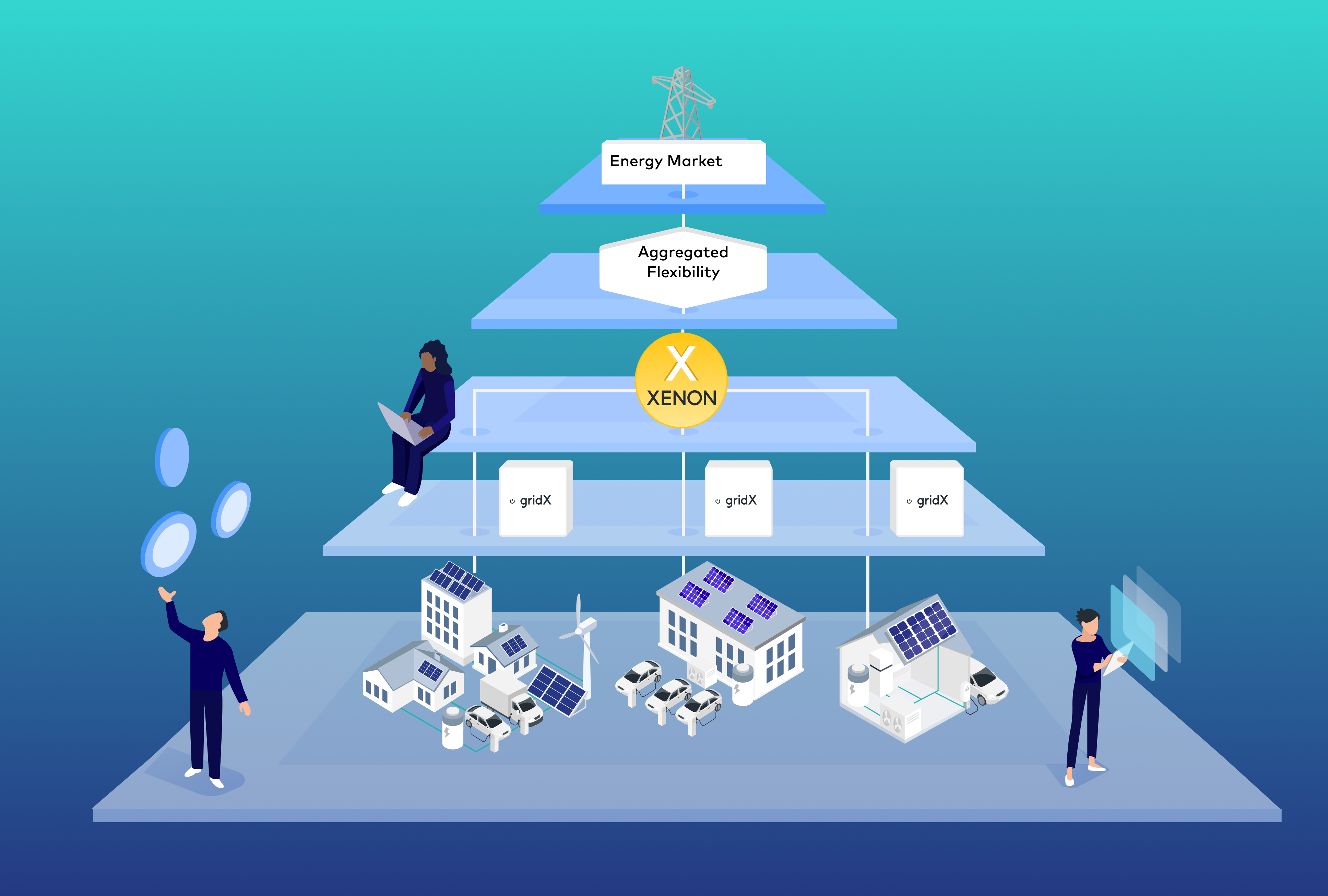
At this top end of the scale, utilities and CPOs translate pooled asset flexibility into direct profitability, moving from cost management to active revenue generation across energy markets. To put this into numbers, gridX actively leverages over 550 megawatt-hours (MWh) of technically managed capacity and triggers more than 40 MWh of activated flexibility per day across its European pool.
- Flexibility forecasting: Predictive software algorithms that analyze historical site data, fleet duty cycles, weather patterns, and market pricing to forecast optimal asset steering paths up to 24 or 48 hours in advance.
- Aggregation and disaggregation: The process of pooling multiple distributed energy resources (DERs) – such as EV chargers, stationary batteries and PV systems across different locations – into a single virtual power plant (VPP). The software aggregates this capacity to meet minimum market trading sizes and then disaggregates incoming grid commands back down to steer individual local assets.
- Multi-asset optimization: The holistic coordination of diverse hardware types behind the meter. The EMS simultaneously manages EV chargers, heat pumps, solar arrays and stationary battery storage (including battery arbitrage and Vehicle-to-Grid / V2G bidirectional power loops), balancing their operational requirements to maximize total site efficiency.
- Multi-market trading: The simultaneous execution of value stacking strategies across multiple country-specific wholesale power and flexibility markets:
- Day-ahead market trading: The standard mechanism in the UK and mainland Europe where electricity prices are auctioned and locked in for each hour of the following day. The EMS maps out charging schedules against these curves to automate consumption during the cheapest hours.
- Intraday market trading: Common in highly volatile markets like Germany and the Netherlands, this involves trading electricity blocks right up to the hour of delivery. The EMS exploits sub-hourly price spreads by rapidly ramping asset consumption up or down.
- Imbalance market trading: Active in regions like the Netherlands where grid operators financially penalize portfolio deviations. The EMS utilizes automated asset steering to actively trade within the imbalance pool, turning grid supply deficits or surpluses into lucrative revenue streams.
- Congestion management and flexibility markets: Local markets where grid operators procure flexibility from asset owners to relieve specific regional bottlenecks. This allows operators to monetize their coordinated asset pools via formalized flexible capacity agreements with the network operator.
Expert insight on the future of electric vehicle charging infrastructures in Europe
There is a pattern that repeats itself across almost every EV charging deployment. An operator installs the hardware, gets the vehicles charged and then, a few months in, starts noticing that the energy bill does not quite make sense. Or that the grid connection is already under strain. Or that a competitor is apparently making money from the same infrastructure.
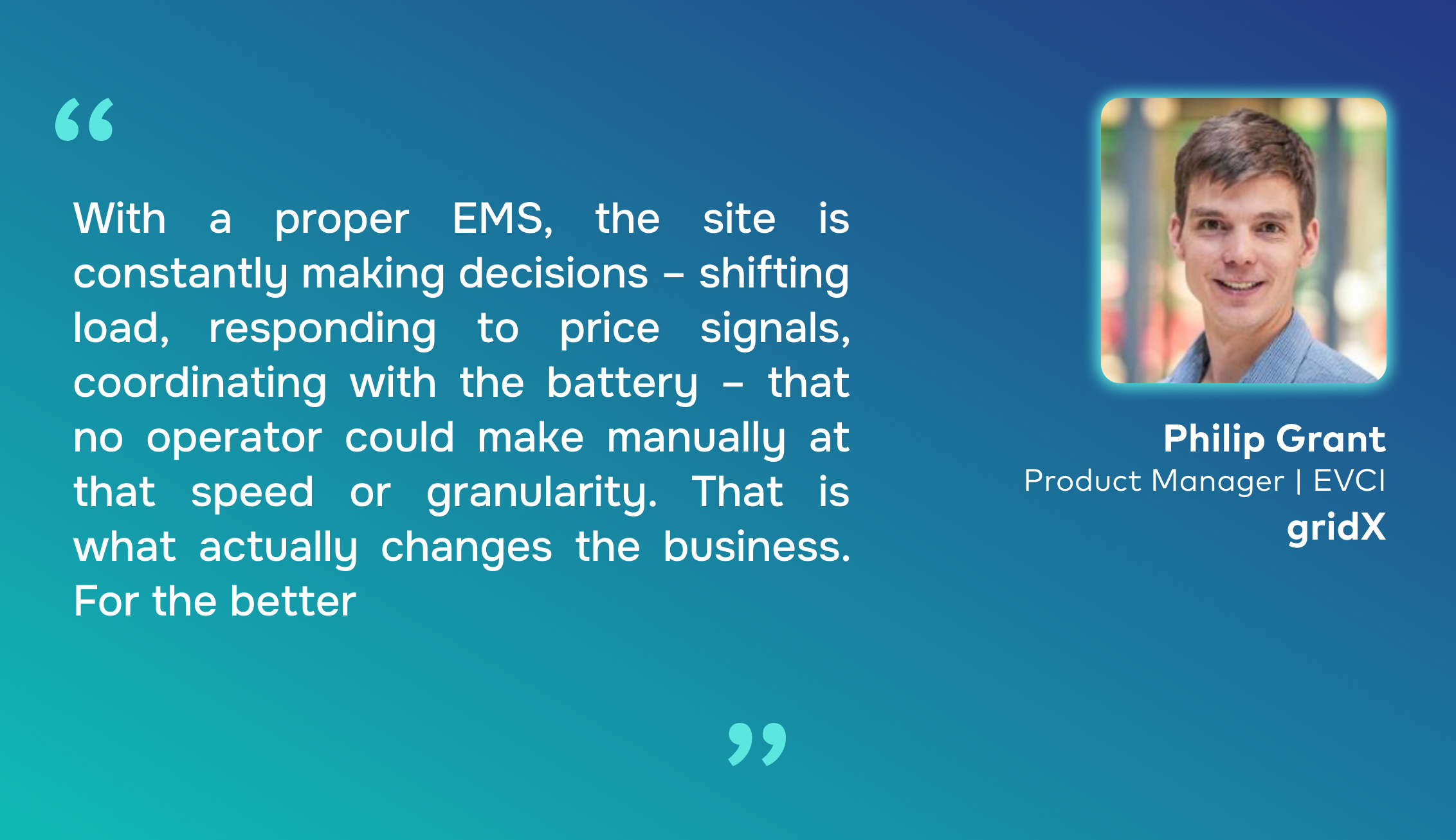
Philip Grant, Product Manager of EVCI at gridX, sees this regularly. “With a proper EMS, the site is constantly making decisions – shifting load, responding to price signals, coordinating with the battery – that no operator could make manually at that speed or granularity. That is what actually changes the business. For the better."
Having an EMS in place changes what the infrastructure is capable of earning. A charge point operating in isolation draws power and creates a cost. Coordinated with a battery, a solar installation and the building's own demand, it becomes an asset that works for the business and, quietly, for something larger.
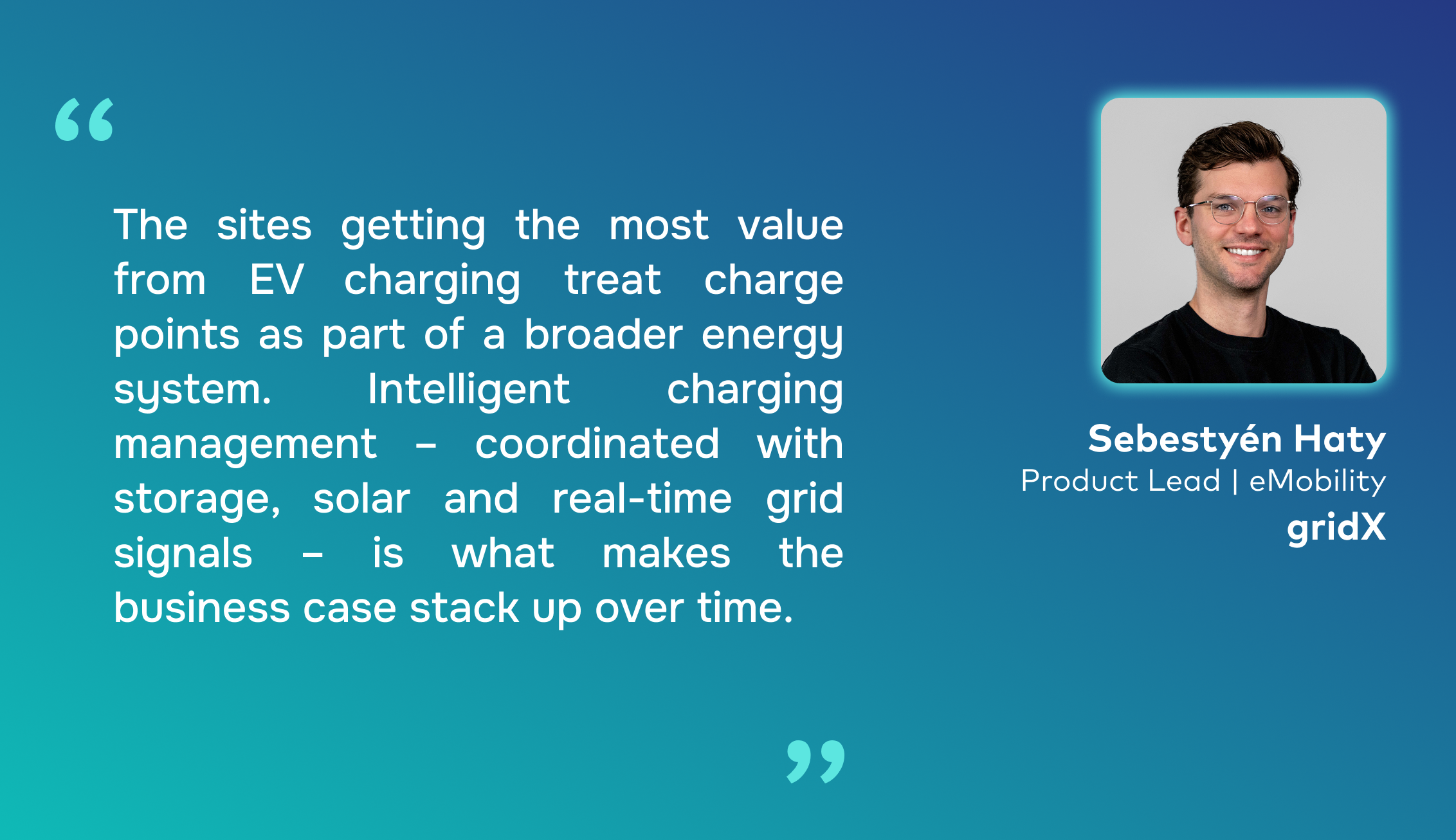
As Sebestyén Haty, Product Lead eMobility at gridX, puts it: "The sites getting the most value from EV charging treat charge points as part of a broader energy system. Intelligent charging management – coordinated with storage, solar and real-time grid signals – is what makes the business case stack up over time. "
An intelligently managed charging site actively supports the transition to a cleaner grid. Every kilowatt-hour shifted to off-peak, every flexibility signal answered, every unit of local solar consumed on site rather than exported is a small contribution to a system under real strain. At the scale Europe needs to reach its net zero targets, that adds up. The operators building toward that future are not doing it out of obligation. They are doing it because, increasingly, it is also where the business case is strongest.


.svg)

.svg)