EV Charging Report 2026

Europe’s EV market matures: The transition from rapid expansion to accelerating charging capacity
Thank you! Your submission has been received!
Oops! Something went wrong while submitting the form.

Executive summary

Europe’s EV market matures: The transition from rapid expansion to accelerating charging capacity

01

The market matures but growth slows Europe’s e-mobility market is maturing. In 2025, BEV growth slowed to 28%, while public charge point expansion dropped to 19%. This reflects a natural plateau as the market scales, with over 1.2 million public charge points now deployed. However, charging capacity growth is accelerating, reaching 36% in 2025, signaling a shift toward more powerful infrastructure.

02

BEVs are cheaper but drive further The market is becoming more accessible. With 63 new BEV models launched in 2025 and declining retail prices, adoption is broadening. Improved battery efficiency and performance are reducing range anxiety, driving sustained demand even as growth rates normalize.

03

Grid constraints are the new barrier As CPOs scale high-power networks, securing grid capacity has become the most critical bottleneck. Traditional infrastructure approaches are no longer sufficient. To deploy more high-power chargers within existing limits, the integration of battery storage at charging sites has become crucial.

04

A clear shift toward high-power charging Despite slower asset growth, average charging power increased to 43 kW, and the share of ultra-fast chargers (>150 kW) rose to 11.8%. Installed capacity per BEV already exceeds regulatory benchmarks, marking the transition from simple network expansion to performance optimization.

05

Nordics and Benelux still lead the charge While the Nordics and Benelux remain the benchmarks for adoption, Eastern Europe is emerging as the new high-growth frontier. Countries like Estonia, Latvia, and Romania are now leading in charging capacity expansion, highlighting fresh opportunities for investment.

06

Flex is a strategic imperative Technologies like dynamic load management and peak shaving allow CPOs to scale without costly grid upgrades. Beyond savings, aggregating EV flexibility opens new revenue streams through energy trading. In this mature market, competitive advantage belongs to those who effectively orchestrate and monetize their networks.

A more stable EV market is taking shape

For the first time, EVs are beginning to outpace petrol cars in parts of Europe, signaling a shift toward more consistent, self-sustaining growth. This is not driven by short-term incentives or policy spikes; the trajectory is becoming steadier, more predictable and increasingly tied to real market demand.

For charging infrastructure, this changes the equation. Demand is rising in a more continuous way, requiring a different approach to planning. One that focuses on how infrastructure is used, optimized and monetized and not just how quickly it is deployed.

Adoption and infrastructure are drifting apart

Comparing BEVs and charge points per capita reveals a fragmented landscape.

Norway continues to lead in EV adoption, while the Netherlands leads in charging density. Other countries cluster into distinct groups, ranging from early adopters to laggards.

In some markets, infrastructure has been built ahead of demand. In others, EV uptake is moving faster than charging availability. Few countries show a balanced relationship between the two.

This divergence reflects different policy choices, investment strategies and grid conditions, shaping how each market evolves.
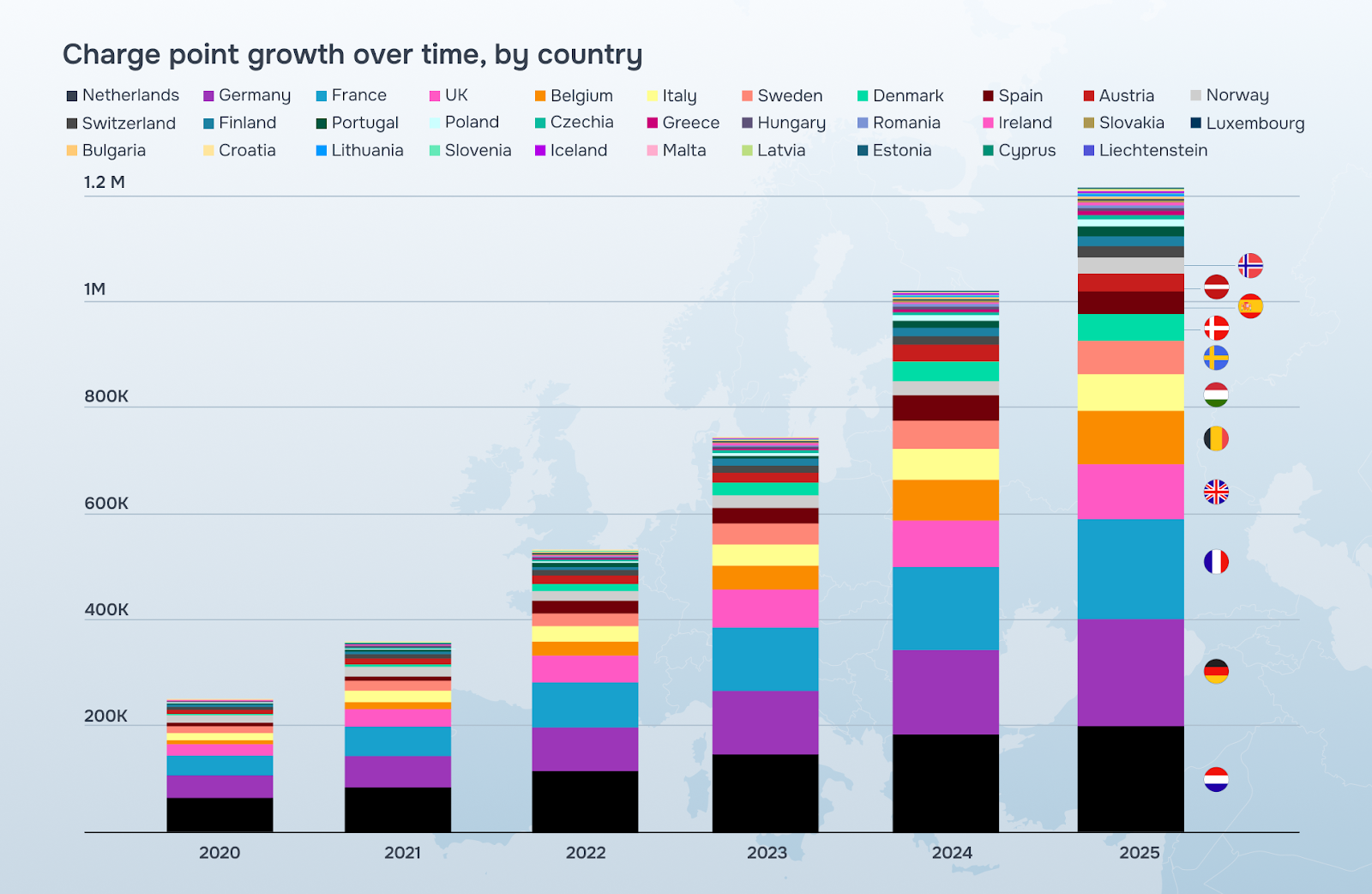
 The 1.2M milestone: From coverage to capacity

Europe’s charging network has surged five-fold since 2020, exceeding 1.2 million public points. While growth is plateauing as the market matures, Denmark and Belgium have skyrocketed by over 1,100%, leapfrogging early adopters.

Meanwhile, the Netherlands, Germany, France, and the UK continue to anchor the system, each growing 200%+ to support a high-performance, mass-market reality.
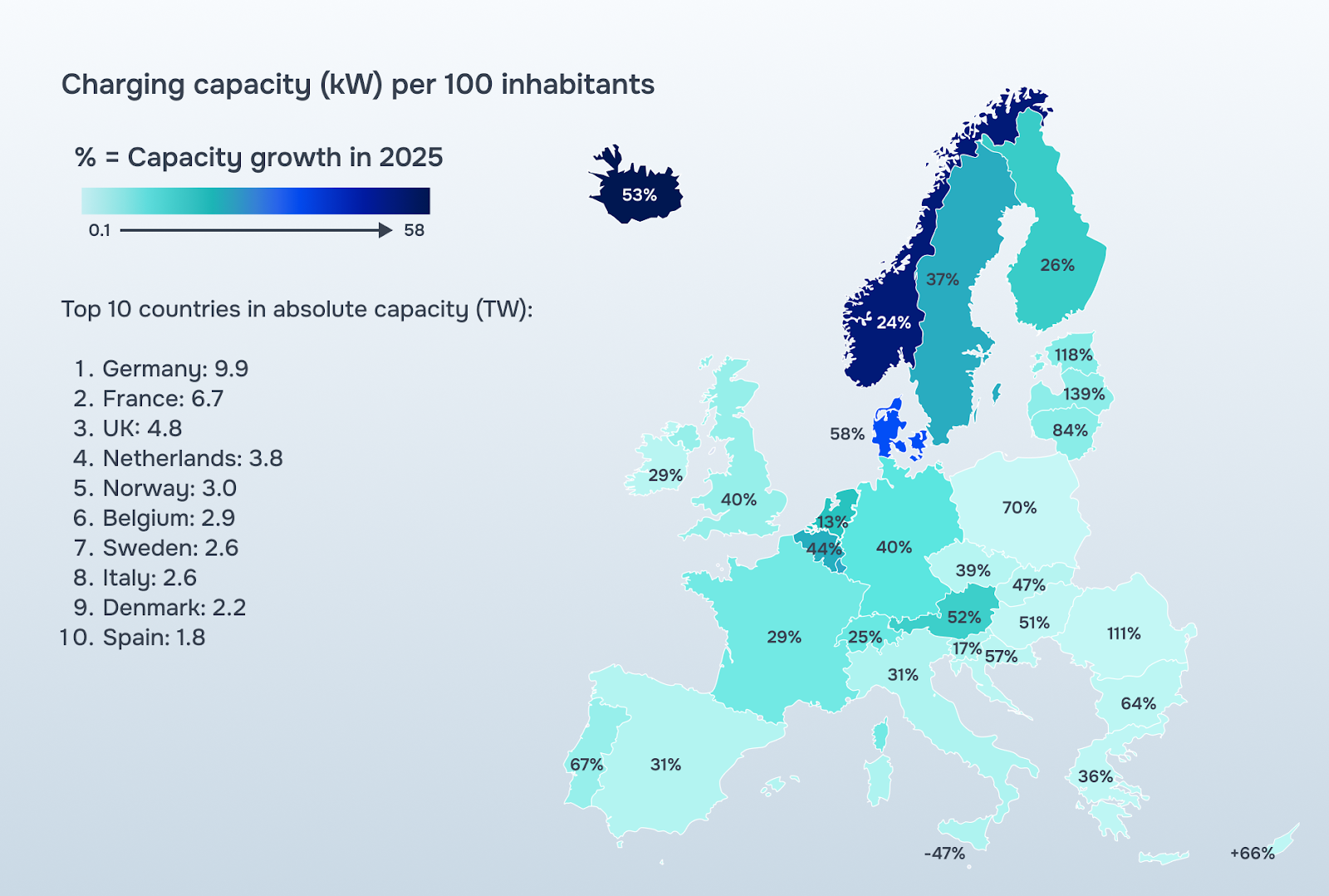
The Nordics: Still the reigning capacity kings

Germany leads in absolute volume, but the Nordics still reign supreme per capita with Iceland and Norway boasting over 50 kW per 100 inhabitants.

Yet, a new power struggle is emerging: Latvia, Estonia, and Romania all more than doubled their capacity in 2025, proving that while the North holds the crown, the East is rapidly ascending the throne.

Get the full report!