

The scaling problem most teams notice too late
The difference between scaling fast and scaling right in energy tech in Europe usually comes down to the ability to do four things: connect a mix of energy assets, install quickly and reliably (meaning low error rates and a high first-time-right rate), absorb regulatory change and open new revenue streams without rebuilding the entire platform every time the market shifts.
These seemingly simple capabilities matter now more than ever as flexibility has climbed up the priority ladder. ACER's 2025 flexibility report found that more than 70% of EU households still lack dynamic pricing contracts, and the European Commission has tied affordability, flexibility and grid modernization together in its 2026 energy agenda.
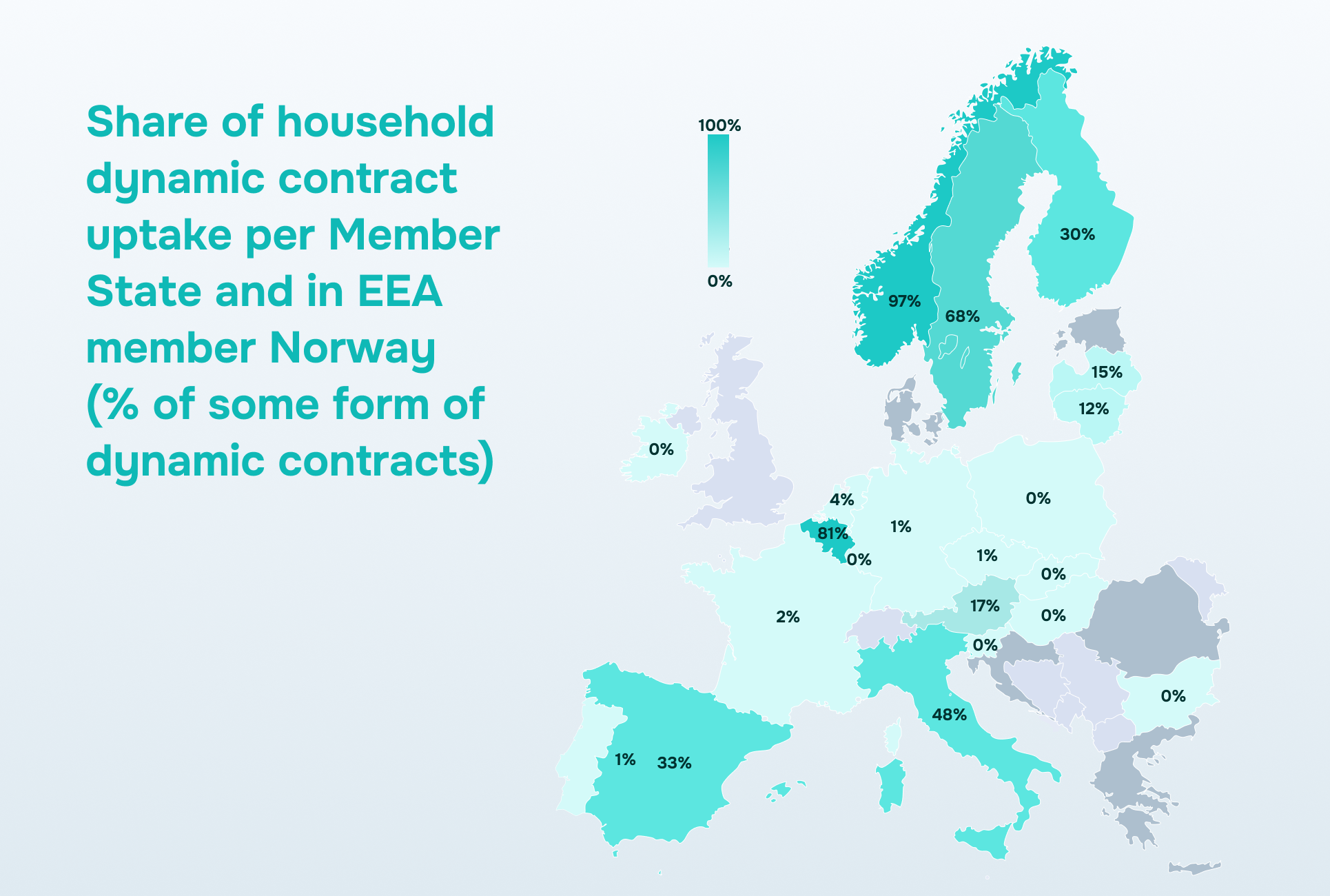
For energy scaleups, that gap is the opportunity. But capturing it requires a home energy management system (HEMS) platform built for more than just today's installs. Energy scaleups implementing such a platform must ask themselves: does the solution grow the business without multiplying operational complexities? If the answer is no, growth can momentarily look healthy on the surface while margins, support load and installer productivity quietly deteriorate underneath.
But this is where most EMS commentary gets it wrong. It fixates on the visible metrics – how many installs, how fast the hardware base is growing – and glosses over the crucial underlying value: how a system actually gets installed without sending a technician to every address, how various asset types from different manufacturers perform reliably over time, and how the platform keeps delivering value beyond self-consumption optimization.
Those three things determine whether a scaleup is building a durable business or just a big headcount problem.
How energy scaleups can use remote installation as a retrofit entry point
The retrofit opportunity isn't hard to find. Across Europe, the installed base of home energy management systems sits at around 3.2% penetration – against a backdrop of millions of households that already own at least one energy asset.
In Germany alone, around five million households could be retrofitted today. In the Netherlands, the phase-out of net metering is creating urgency for residential solar owners to adopt storage, with 1.2 to 1.8 million Dutch solar households now representing a direct retrofit opportunity. Home batteries are projected to increase elevenfold between 2025 and 2030, growing from around 1.3 GWh to 14.6 GWh as consumers seek to use solar energy more efficiently. In the UK, only 1.6 million homes currently have solar panels out of 27 million total households, leaving an enormous addressable base waiting to be connected.
A gridX survey found that across Germany, the Netherlands and the UK, two-thirds of asset owners plan to purchase at least one additional device within two years, and 44% of those with only a rooftop photovoltaic (PV) system say they want to add a home battery. The demand exists. The question is how to reach it without sending a qualified technician to every address.
For energy scaleups, that existing base of PV owners is the market – the question is how to reach them without the cost structure of a full installation visit.
This is where retro-connect becomes commercially viable.

When a customer already has a PV system at home, connecting them to an HEMS doesn't require an electrician on site. The gridBox can be shipped directly to the customer while back-office teams guide asset preparation remotely – via tools like TeamViewer or native remote configuration. The gridX Installer Hub is built to be completed without a local network connection to the gateway. Unlike some competitors, where the installation wizard only works if the installer is physically present and connected to the device, gridX allows the entire setup to happen via the cloud.
The goal for energy scaleups here isn't connectivity for its own sake: it's acquisition. As Timo Streckfuß, Product Manager for Installer Experience Lead at gridX, puts it:
"Energy scaleups don't want to just connect a customer. They want to build long-term customer relationships. Retro-connect is often the first step: remotely onboarding existing PV systems at scale and monitoring performance over time. That creates the opportunity to later offer additional assets like batteries or EV chargers without the high acquisition costs of finding a new customer.”
Timo says that strategy only works if onboarding can happen fast enough to scale operationally. He adds,
“If customer onboarding takes too long or requires too many on-site visits, scaling becomes much harder operationally. Today, 63% of gridX installations are completed in under 10 minutes, and asset discovery takes less than 90 seconds on average. That kind of operational efficiency is what makes remote-first retrofit models scalable.”
For teams running thousands of installs across Europe, that speed at the retro-connect stage means the cost of customer acquisition stays low enough for the upsell margin to actually matter.
Why hybrid connectivity matters in Pan-European rollouts
Remote installation solves the installer side of the retrofit problem. The harder side is the assets themselves.
In any cross-border rollout, you'll encounter every possible combination: older PV inverters that need a local gateway, newer electric vehicle (EV) chargers with fully exposed cloud APIs, markets with strict regulatory requirements and markets where shipping hardware slows everything down. Gateway-only platforms need a hardware install for every asset, even where a cloud API would do. Pure cloud platforms cannot reach older or more complex homes at all.
A hybrid model handles both in the same platform. Partners choose per asset and per market:
Cloud-to-cloud connectivity is the fastest path to scale. Assets onboard directly via their manufacturer's cloud API with no hardware to ship, no install appointment and no on-site dependency. For energy scaleups entering new markets or rolling out EV flexibility at speed, this is where the biggest time and cost gains are.
For homes with older assets or more complex setups, the gridBox – our local gateway – handles what cloud connectivity cannot reach: direct local control, multi-asset coordination and full offline resilience.
The hybrid setup runs both on the same platform. It is a deliberate architectural decision that lets partners match the connectivity method to the asset, the market and the customer without switching platforms or rebuilding their stack.
gridX already runs this model at scale: 230,000 energy assets connected across 15 countries, including nearly 15,000 EVs via cloud-to-cloud (as of May 2026).
gridX is unique in the industry as its platform offers connectivity via both cloud-to-cloud or a local gateway. Gateway-only vendors are staying gateway. Cloud-only vendors are staying cloud.
For a scaleup expanding across EU markets, this means one platform that fits every asset mix in every country. No rip-and-replace when crossing a border. No capped retrofit rate because certain assets do not support a cloud path.
A platform built for flex, not just savings
Here is a question worth asking your EMS vendor: what is our revenue ceiling with this platform in three years?
Most HEMS platforms are built around self-consumption optimization. Some extend into optimization according to dynamic time-of-use tariffs. That is roughly where the architecture stops. For a scaleup serious about flexibility business models, that ceiling arrives faster than expected.
BCG's 2025 EMS analysis makes the point clearly: early flex use cases can already generate around €350 to €450 per single-family home each year. And those value pools are projected to overtake traditional EMS value pools in Germany between 2030 and 2035. The gap between platforms that can participate in those markets and platforms that cannot will define a generation of energy businesses.
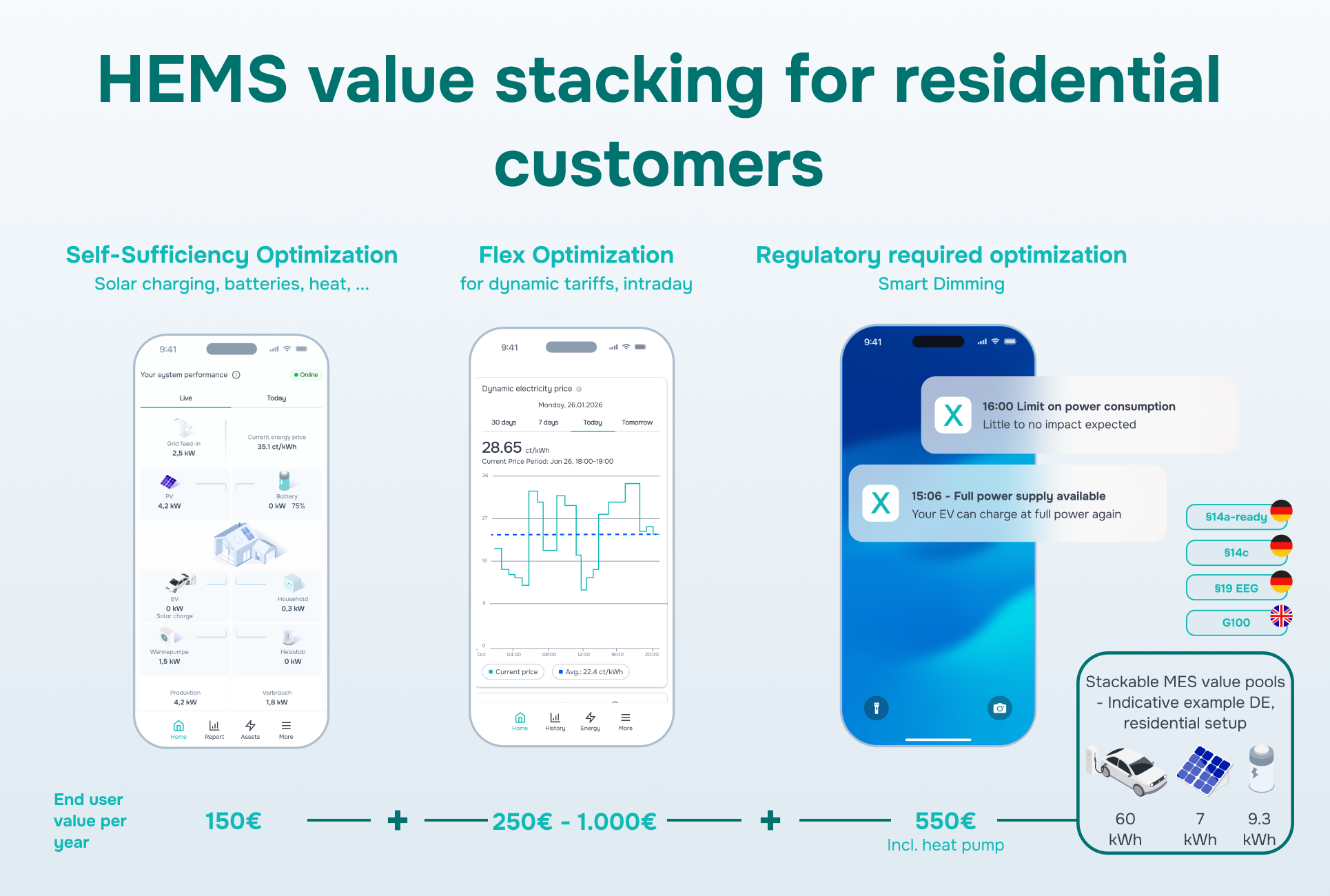
The numbers bear that out. A household running basic self-consumption optimization saves around €125 per year. Add dynamic tariffs logic and that rises to roughly €447. Stack in aggregation of flexibility for intraday participation, grid services and dynamic grid fees and the upper-end scenario reaches €1,750.
Optimized German setups combining an EMS, PV, battery, dynamic tariffs and §14a Module 3 can reach €2,149 per year at the upper end. Just a little caveat: these are best-case figures, not averages. But the direction is consistent and the gap between optimization layers is significant.
As Irene Guerra Gil – gridX’s Energy Market Expert – emphasized, “The revenue gap between a platform that stops at self-consumption optimization and one built for full flexibility participation is only going to widen. The architecture decision you make today is essentially a bet on how much of that value you want access to and how much you want to pass on to your customers.”
That trajectory is backed by broader market signals. ACER's 2025 report highlights that more than 70% of EU households still lack dynamic pricing contracts and calls for stronger price signals and simpler market access for smaller flexibility providers. The IEA's 2026 electricity outlook notes that home battery storage in Germany already exceeds grid-scale storage capacity. The assets are there. The question is whether the software can turn them into revenue.
gridX's XENON Flex architecture is built to handle the full stack: self-consumption, dynamic tariffs, §14a Module 3, intraday trading and direct marketing, running together where regulation and market readiness allow. The aggregation and disaggregation layer is already part of the platform.
For any energy scaleup making a platform decision today, that distinction matters. If the system handles only baseline optimization, every future flex market becomes a custom build or a migration project. If the architecture already supports stacked value streams, new opportunities can be added without rebuilding the commercial model.
You simply expand and grow.
Built to ship fast, built to stay stable
One thing that rarely comes up in EMS vendor conversations is software cadence. How often does the platform actually improve, and what happens when an update goes wrong?
Legacy providers often ship updates once a week, sometimes less. In energy, that is slow. ACER's 2025 electricity market integration report shows volatility across day-ahead, intraday and balancing timeframes. Germany's evolving grid-fee regime under §14a keeps moving. The Oxford Institute for Energy Studies noted in a 2026 paper that dynamic tariffs require control systems that can translate changing price signals into device-level action in near real time. Slow product cycles delay fixes, device compatibility and regulatory response. And yes, that is a technical and commercial problem.
gridX ships 15 to 20 updates to production every single day, with less than a minute of downtime per month on the external API. Last month (April 2026) that number was zero. Increasing rollout frequency went hand in hand with higher test automation levels and improved observability and alerting. Going this route significantly reduced roll-out risks.
How that works in practice is worth understanding. Every change runs through an automated test suite before it touches any user. From there, it goes to a staging environment with no real users, then to what the engineering team calls a canary deployment.

Wolfgang Werner, Head of Platform at gridX, explains it succinctly,
"The name comes from the canary in the coal mine. Miners would bring a canary into the shaft because it would react to carbon monoxide before humans could detect it. We do the same thing with software. A new release goes to a small slice of the fleet first. If something breaks, we catch it there. Roll back, investigate, fix and roll out again. This often happens within hours or even minutes. If the metrics look good, a human approves the next step, and it rolls out to everyone.This way we balance automated testing, small-scale field testing and human accountability to achieve both high velocity and robustness."
If something does go wrong in production, rolling back is a single button click. The same pipeline that promotes a release can reverse it just as fast.
The platform is also built to absorb spikes. Our architecture allows most gridX public-facing services to scale elastically: when request volume climbs past a threshold, additional instances spin up automatically. When load drops, they wind back down.
During incidents – e.g. large internet disruptions – where gridBoxes temporarily lose connectivity, they cache data locally and re-ingest it once the connection is restored. Under those conditions the platform regularly handles two to five times its normal load without degradation. Normal operations run at between 15,000 and 25,000 requests per second.
For a scaleup adding thousands of assets across multiple markets, that kind of infrastructure is what keeps growth from becoming a support problem.
What to ask before you commit to a white-label EMS platform
The buying decision here is not whether an EMS looks polished in a demo or covers today's minimum use cases. It is whether it reduces site visits, shortens time to first value, works across mixed hardware assets and leaves room to grow revenue as flexibility markets mature.
Three questions worth putting to any EMS vendor:
Are there multiple connectivity options to match your and your customers’ changing needs?
Gateway control and cloud-to-cloud in the same customer estate, or is one route effectively forced? Ask for proof of live deployments at scale.
Which value layers are live today?
Separate self-consumption, dynamic tariffs, flexibility market participation and grid-fee optimization. Anything beyond live deployments should be clearly labeled as roadmap, not implied capability.
How fast does the platform adapt in production?
Review release cadence, rollback practice and how compliance changes are shipped into the field. Slow release discipline becomes a margin problem in volatile or rule-heavy markets.
What will separate the next energy tech winners
Energy tech is entering a tougher and more valuable phase. The easy growth story of adding more assets and hoping software catches up later is wearing thin. Public evidence from regulators, researchers and market analysts points in the same direction: flexibility matters more, interoperability still lags and the companies with the best shot at durable growth are the ones that connect devices, react to market signals and keep updating without slowing the field down.
The next winners in renewable tech will not be chosen by who installs the most boxes first. They will be chosen by whose platform keeps growth efficient once the straightforward installs are gone.
Ready to scale without the complexity? Get in touch to learn how gridX can accelerate your growth.


.svg)

.svg)